Maths games for Nursery to Year 5
Pompom Kids has 27 maths games that follow the English National Curriculum for maths, from counting to five in Nursery to fractions, decimals and percentages in Year 5. Every question is read aloud, so children who are not yet reading can still play.
The games lean on pictures first: ten-frames, number lines, place-value blocks, arrays and fraction bars. That is how children learn in school (concrete, then pictorial, then abstract), and it means a wrong answer can show why it was wrong. The same game grows with the child: Hop the Line counts to 10 in Reception and bridges through 100 in Year 3.
- Nursery and Reception (ages 3 to 5): counting, subitising (seeing how many without counting), comparing and number bonds to 10.
- Years 1 and 2 (ages 5 to 7): addition and subtraction to 100, place value in tens and ones, the 2, 5 and 10 times tables, halves and quarters, time and money.
- Years 3 and 4 (ages 7 to 9): all times tables to 12 × 12, ready for the Year 4 Multiplication Tables Check, column methods, fractions and Roman numerals.
- Year 5 (ages 9 to 10): numbers to a million, negative numbers, factors and primes, decimals and percentages, angles and measures.
Counting Hill: counting, seeing numbers and bonds
Counting Hill builds number sense: counting, seeing amounts at a glance, comparing, number bonds, doubling and halving, and the number line.

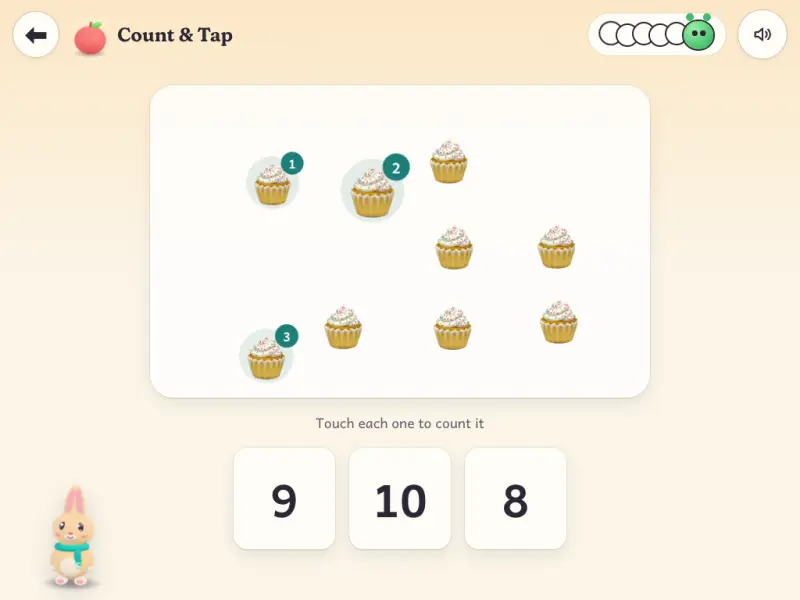
Count & Tap
Number: counting · Nursery to Year 1 (ages 3 to 6) · Free
One-to-one counting: touch each thing once (it gets a number), and the last number tells you how many.
What it practises in each year
- Nursery: Count up to 5 objects, touching each once (one-to-one correspondence).
- Reception: Count up to 10 objects; the last number says how many (cardinality).
- Year 1: Count up to 20 objects accurately and reliably.
Quick Look
Number: subitising · Nursery to Year 1 (ages 3 to 6) · Free
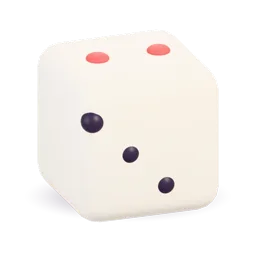
Subitising: seeing small amounts at a glance using dice and ten-frame patterns. Peek again as often as you like.
What it practises in each year
- Nursery: See up to 3 at a glance without counting.
- Reception: Subitise up to 5 and recognise dice and ten-frame patterns.
- Year 1: Recognise amounts to 10 using ten-frame structure (5 and a bit).
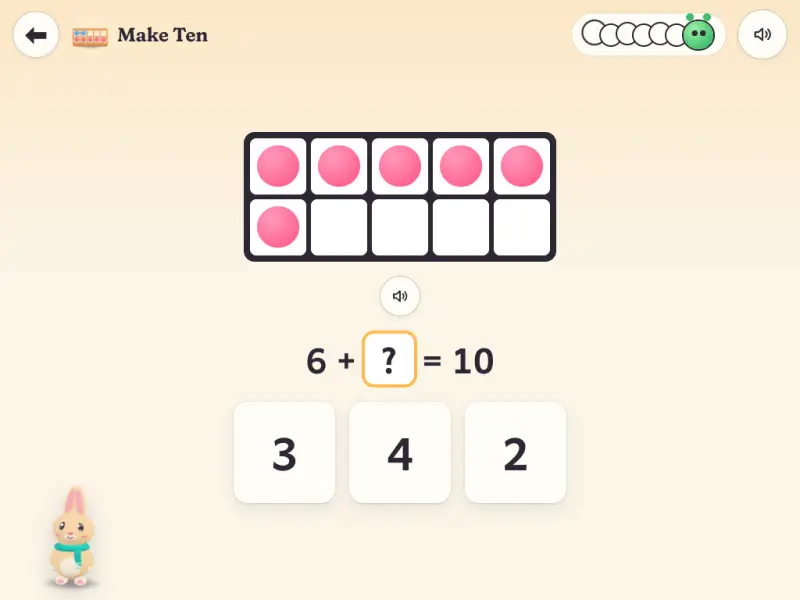
Make Ten
Number: number bonds · Reception to Year 2 (ages 4 to 7) · Members
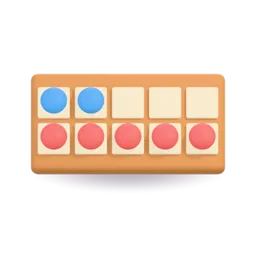
Number bonds with five and ten frames: how many more to fill the frame? Bonds to 5 (Reception), 10 (Y1) and 20 (Y2).
What it practises in each year
- Reception: Know number bonds to 5 and some to 10 (ELG: Number).
- Year 1: Recall number bonds to 10 and 20 (NC Y1 Addition and Subtraction).
- Year 2: Recall and use bonds to 20 fluently and derive bonds to 100.
Hop the Line
Number: number lines, addition and subtraction · Reception to Year 3 (ages 4 to 8) · Free
Pompom hops along a number line, modelling counting on and back, jumping in tens and bridging through 100. The child reads where Pompom lands.
What it practises in each year
- Reception: Count along a 0–10 number line to find where a number is (ELG: Number, counting and number sense).
- Year 1: Add and subtract one-digit numbers within 20 by counting on and back on a number line.
- Year 2: Add and subtract multiples of 10 to and from a 2-digit number, jumping in tens on a number line.
- Year 3: Add and subtract ones across a hundred boundary by partitioning the jump (bridge through 100).
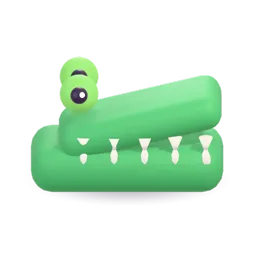
Hungry Croc
Number: comparing numbers · Reception to Year 3 (ages 4 to 8) · Free
Comparing amounts: the hungry croc’s mouth always opens towards the bigger amount, which turns into the < and > signs.
What it practises in each year
- Reception: Compare two groups up to 10 (more, fewer or the same) and find one more or one less than a number (ELG: Number).
- Year 1: Compare numbers to 20 using <, > and =, seeing them as tens and ones.
- Year 2: Compare numbers to 100 using <, > and =, using tens and ones (base-10) to decide.
- Year 3: Compare numbers to 1,000 using <, > and =, looking at hundreds, then tens, then ones.

Doubles & Halves
Number: doubling and halving · Year 1 to Year 3 (ages 5 to 8) · Members
Doubling with a mirror (a ladybird’s matching wings, then base-10 blocks) and halving by sharing into two equal groups.
What it practises in each year
- Year 1: Double numbers to 5 (totals to 10) and find half of even numbers to 20 by sharing into two equal groups.
- Year 2: Recall doubles to double 10 and halves to 20, and double and halve multiples of 5 and 10 to 50.
- Year 3: Double and halve multiples of 10 and 100 (to 1,000) using known facts and place value.
Block Quarry: place value, calculating and rounding
Block Quarry is about how numbers are built: place value, rounding, column addition and subtraction, negative numbers and Roman numerals.
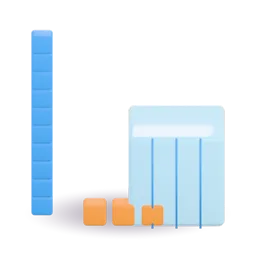
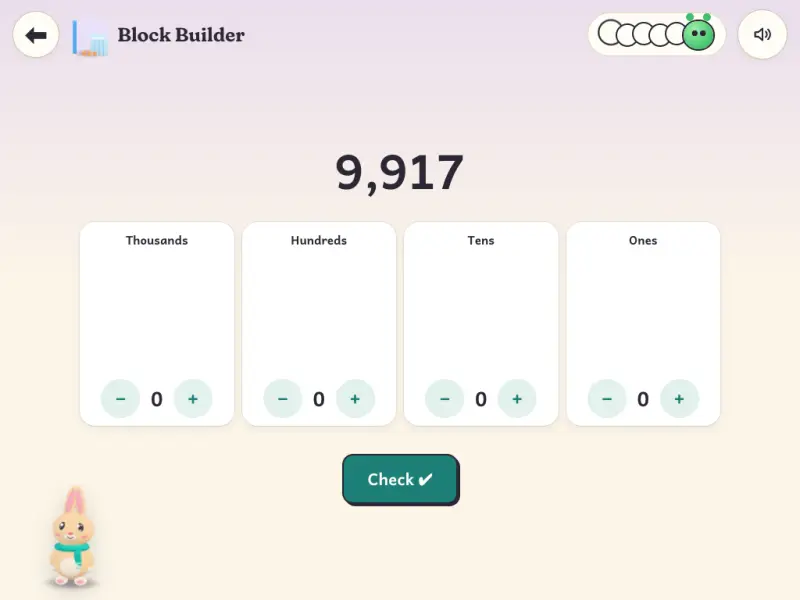
Block Builder
Place value · Year 1 to Year 5 (ages 5 to 10) · Free
Place value with base-ten blocks: make the number from ones, tens, hundreds and thousands. Up to 100 (Y2), 1,000 (Y3) and 10,000 (Y4+).
What it practises in each year
- Year 1: Represent numbers to 20 as tens and ones.
- Year 2: Know the value of each digit in a 2-digit number.
- Year 3: Know the value of each digit in a 3-digit number.
- Year 4: Work with 4-digit numbers: thousands, hundreds, tens and ones.
- Year 5: Read and represent numbers to 1,000,000.
Column Calculator
Addition and subtraction: formal written methods · Year 3 to Year 5 (ages 7 to 10) · Free
Column addition and subtraction, one column at a time, beside place-value counters that really move when ten are exchanged for one (and back).
What it practises in each year
- Year 3: Add and subtract numbers with three digits using columnar addition and subtraction, exchanging between columns.
- Year 4: Add and subtract numbers with up to four digits using columnar methods with exchange.
- Year 5: Add and subtract whole numbers with more than four digits using formal written column methods.
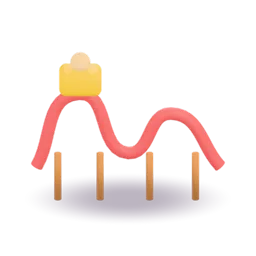
Rounding Rollercoaster
Number: rounding · Year 3 to Year 5 (ages 7 to 10) · Members
Rounding on a rollercoaster: the number sits on a hill between two multiples, and the halfway point at the top decides which way it rolls.
What it practises in each year
- Year 3: Round numbers to 1,000 to the nearest 10 and the nearest 100, using the halfway point on a number line.
- Year 4: Round any number to 10,000 to the nearest 10, 100 or 1,000.
- Year 5: Round any number up to 1,000,000 to the nearest 10, 100, 1,000, 10,000 and 100,000.
Roman Road
Number: Roman numerals · Year 3 to Year 5 (ages 7 to 10) · Members
Roman numerals on a clock face, carved milestones and years, plus building numerals from tiles, biggest part first.
What it practises in each year
- Year 3: Tell and write Roman numerals from I to XII on a clock face.
- Year 4: Read Roman numerals to 100 (I to C), write numbers as Roman numerals, and build them from tiles, biggest part first.
- Year 5: Read Roman numerals to 1,000 (M) and recognise years written in Roman numerals.
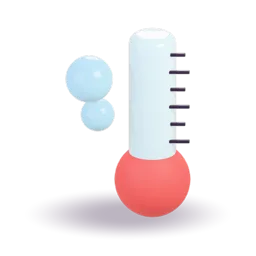
Frosty Thermometer
Number: negative numbers · Year 4 to Year 5 (ages 8 to 10) · Members
Negative numbers on a thermometer: read the temperature, count through zero as it warms or cools, and find differences by jumping to zero first.
What it practises in each year
- Year 4: Read temperatures from −10 °C to 10 °C and count forwards and backwards through zero to include negative numbers.
- Year 5: Interpret negative numbers in context, count through zero from −20 °C to 20 °C and find the difference between two temperatures.
Times Tower: times tables, sharing and factors
Times Tower practises multiplication and division facts until they are instant, then uses them for sharing, grouping, factors and multiples.
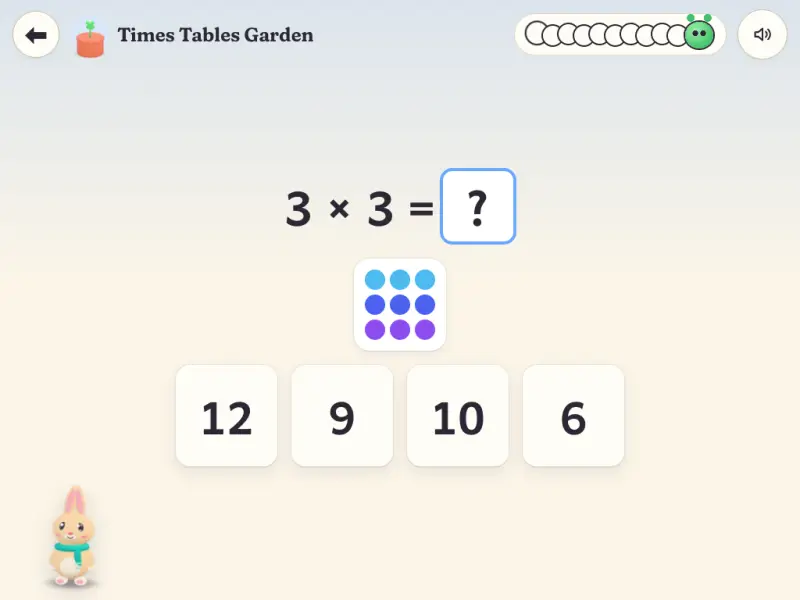
Times Tables Garden
Multiplication: times tables · Year 2 to Year 5 (ages 6 to 10) · Free
Times tables with arrays (pictures of rows) that fade as facts get secure. Facts you find tricky come back more often.
What it practises in each year
- Year 2: Recall ×2, ×5 and ×10 facts using arrays.
- Year 3: Recall ×3, ×4 and ×8 facts.
- Year 4: Recall all facts to 12 × 12 (NC Y4).
- Year 5: Keep all tables fluent; use them to derive related facts.
Times Check Practice
Multiplication: times tables check · Year 4 to Year 5 (ages 8 to 10) · Members
Practice in the format of the Year 4 Multiplication Tables Check: 25 questions, 6 seconds each, typed answers. For familiarity only — no pass mark.
What it practises in each year
- Year 4: Practise the Multiplication Tables Check format: 25 questions, 6 seconds each.
- Year 5: Keep times-table recall automatic under light time pressure.
Share the Sweets
Division: sharing and grouping · Year 1 to Year 3 (ages 5 to 8) · Members
Division with real dealing: tap jars to share sweets one at a time (fairly), or fill bags to make groups. Leftovers show remainders.
What it practises in each year
- Year 1: Solve division problems by sharing objects equally between 2 or 4 (concrete objects and pictures).
- Year 2: Calculate division facts for the 2, 5 and 10 times tables, by sharing (÷2) and grouping (÷5, ÷10), and write them with ÷ and =.
- Year 3: Divide by 3, 4 and 8 by sharing and grouping, seeing remainders as the sweets left over.
Factor Flowers
Multiplication: factors, multiples and primes · Year 4 to Year 5 (ages 8 to 10) · Members
Factors as rectangles: arrange squares in rows until no square is left over. Every rectangle grows a flower; a prime only ever makes one row.
What it practises in each year
- Year 4: Recognise and use factor pairs by arranging squares into rectangle arrays, and find missing factors (commutativity).
- Year 5: Identify factors and factor pairs, multiples, prime numbers to 100 and square numbers.
Fraction Café: fractions, decimals and percentages
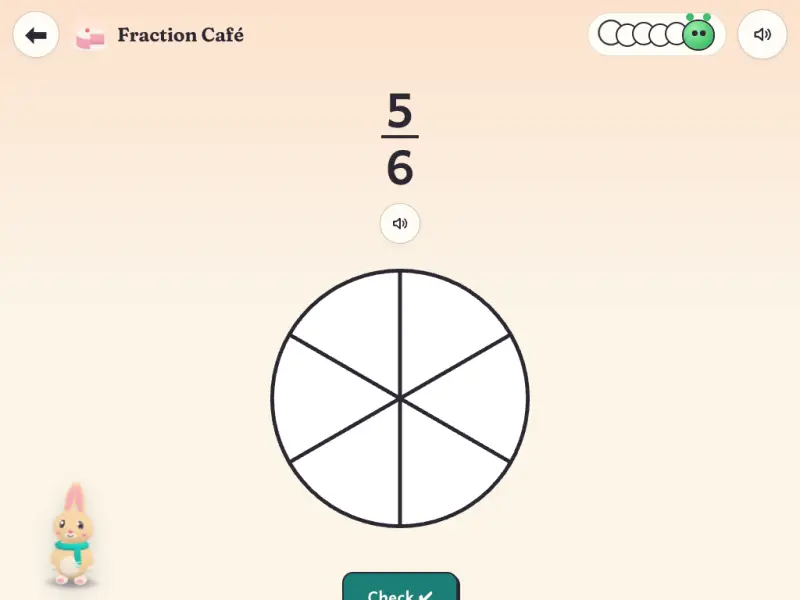
Fraction Café starts with halves of a cake and finishes with decimals and percentages, always with a picture to see what the fraction means.
Fraction Café
Fractions: parts of a whole · Year 1 to Year 5 (ages 5 to 10) · Free
Fractions of shapes: colour in the parts. Halves and quarters (Y1), thirds (Y2), then any fraction (Y3+).
What it practises in each year
- Year 1: Recognise a half and a quarter of a shape.
- Year 2: Recognise 1/3, 1/4, 2/4 and 3/4 of a shape.
- Year 3: Recognise unit and non-unit fractions with small denominators.
- Year 4: Find fractions of shapes with denominators up to 12.
- Year 5: Shade non-unit fractions of shapes fluently and link them to equivalent fractions.

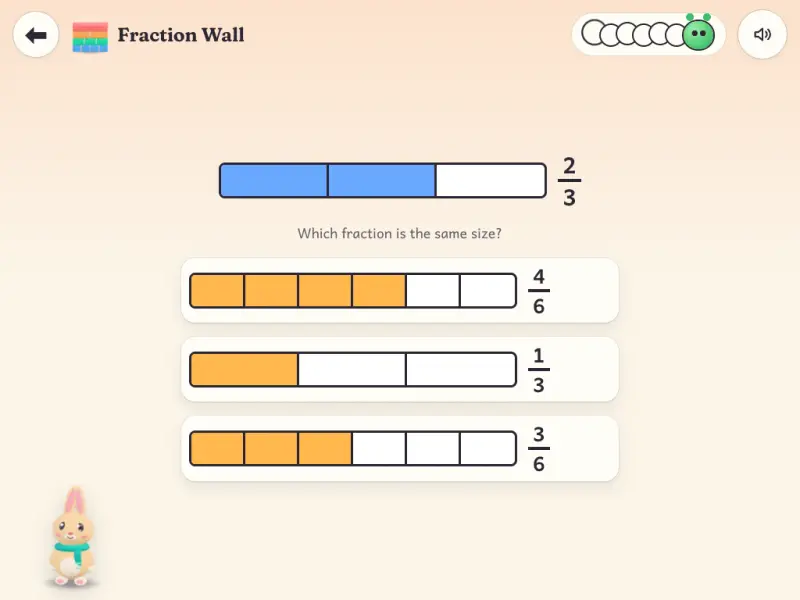
Fraction Wall
Fractions: equivalence and comparison · Year 3 to Year 5 (ages 7 to 10) · Members
Equivalent fractions and comparing fractions using a fraction wall (bar model), so the size is always visible.
What it practises in each year
- Year 3: Recognise equivalent fractions with small denominators using diagrams.
- Year 4: Find families of equivalent fractions.
- Year 5: Compare and order fractions whose denominators are multiples of the same number.

Decimal Dash
Fractions: decimals and percentages · Year 4 to Year 5 (ages 8 to 10) · Members
Decimals on a race track and a hundred square: tenths, hundredths and thousandths, matched to fractions, then percentages as “out of 100”.
What it practises in each year
- Year 4: Recognise tenths and hundredths on a number line and a hundred square, and write fractions such as 3/10, 45/100, 1/4, 1/2 and 3/4 as decimals.
- Year 5: Read thousandths on a number line, relate thousandths to decimals, and understand per cent as out of 100 by shading a hundred square and matching decimals to percentages.
Shape Park: shapes, patterns, time, money and measures
Shape Park covers geometry and measurement: 2D and 3D shapes, symmetry, angles, position, time, money, length, mass and capacity, and simple charts.
Shape Hunt
Geometry: properties of shapes · Nursery to Year 3 (ages 3 to 8) · Free
Shape spotting that grows with your child: matching, naming turned shapes, then counting sides, faces and right angles, with every count modelled.
What it practises in each year
- Nursery: Match shapes that are the same, noticing shape rather than colour (EYFS: shape and spatial reasoning).
- Reception: Name circles, triangles, squares and rectangles of any size, even when they are turned (ELG: Number and shape).
- Year 1: Recognise and name common 2-D shapes (rectangles, circles, triangles, pentagons, hexagons) and 3-D shapes (cubes, cuboids, pyramids, spheres, cylinders, cones).
- Year 2: Identify the number of sides and vertices of 2-D shapes, and faces, edges and vertices of 3-D shapes.
- Year 3: Identify right angles in shapes, and recognise horizontal, vertical, parallel and perpendicular lines.

Pattern Train
Patterns: repeating and growing · Nursery to Year 1 (ages 3 to 6) · Members
Repeating patterns on train carriages: what comes next, fix the wrong carriage, then growing towers and counting in 2s, 5s and 10s.
What it practises in each year
- Nursery: Continue a simple AB repeating pattern of colours and shapes (EYFS: talk about and continue patterns).
- Reception: Continue, copy and correct ABB, AAB and ABC repeating patterns, spotting the mistake (ELG: Numerical Patterns).
- Year 1: Continue growing patterns and number patterns, counting forwards and backwards in 2s, 5s and 10s (NC Y1 Number).
Tick-Tock Clock
Measurement: time · Year 1 to Year 5 (ages 5 to 10) · Free
A friendly analogue clock you set with big + and − buttons (or by dragging the hands), and read: o’clock and half past up to 24-hour time, durations and timetables.
What it practises in each year
- Year 1: Tell the time to the hour and half past the hour, and draw the hands on a clock face to show these times.
- Year 2: Tell and show the time to five minutes, including quarter past and quarter to the hour.
- Year 3: Tell and set the time to the nearest minute on an analogue clock, including clocks with Roman numerals I to XII.
- Year 4: Read, write and convert time between analogue and digital 12-hour and 24-hour clocks.
- Year 5: Solve problems involving durations and timetables, and find a time a given number of minutes later.
Piggy Shop
Measurement: money · Reception to Year 3 (ages 4 to 8) · Free
A toy shop with simple, original coin drawings: find coins, pay the exact price, find another way to pay, then give change by counting on.
What it practises in each year
- Reception: Recognise 1p, 2p, 5p and 10p coins, whatever their size or way up.
- Year 1: Recognise coins and pay exact amounts up to 20p by combining coins.
- Year 2: Combine coins and notes to pay amounts in pounds (£) and pence (p), and find different combinations that make the same amount.
- Year 3: Add and subtract amounts of money to give change, counting on from the price, using both £ and p.
Measure Up
Measurement: length, mass and capacity · Year 1 to Year 4 (ages 5 to 9) · Members
Reading rulers, kitchen scales and measuring jugs, with intervals that get harder each year, plus comparing, ordering and converting units.
What it practises in each year
- Year 1: Compare lengths, masses and capacities (longer/shorter, heavier/lighter, fuller/emptier); measure in whole centimetres and read a scale marked in 1s.
- Year 2: Read rulers in cm, and scales and jugs going up in 2s, 5s and 10s (kg, g, ml); compare measures using <, > and =.
- Year 3: Measure in cm and mm (including from a non-zero start), read scales in steps of 5, 10 and 100 g or ml, and compare mixed units.
- Year 4: Read scales with harder intervals (20, 25, 50, 100) including kg and g, measure in mm from any start, and convert between units.

Mirror Painter
Geometry: symmetry · Year 2 to Year 4 (ages 6 to 9) · Members
Paint squares to finish a picture so it matches in the mirror line. Check shows exactly which squares are wrong or missing; after two tries the reflection is painted for you.
What it practises in each year
- Year 2: Complete a symmetric pattern on a grid with a vertical mirror line.
- Year 3: Complete symmetric patterns with a vertical or a horizontal mirror line, painting more squares.
- Year 4: Complete a simple symmetric figure with respect to a specific line of symmetry, including a diagonal line (NC Y4).
Chart Explorer
Statistics: charts and tables · Year 2 to Year 5 (ages 6 to 10) · Members
Charts about fruit, pets, minibeasts and ice creams (fresh data every time): pictograms, tallies, bar charts, tables and line graphs, with the working shown.
What it practises in each year
- Year 2: Interpret simple pictograms, tally charts and tables; answer questions by counting and comparing, and find totals of two groups.
- Year 3: Interpret pictograms where one picture stands for 2 or 5, bar charts and tables; solve one-step “how many more” and total questions.
- Year 4: Interpret bar charts with scales of 5 and 10 and tables of data; solve comparison, sum and difference problems.
- Year 5: Read and interpret line graphs and tables; solve comparison, sum and difference problems using the information shown.
Treasure Map
Geometry: position and direction · Reception to Year 5 (ages 4 to 10) · Members
Pirate-map position and direction: where is the animal, which way after a turn, programming a floor robot, then coordinates and translations.
What it practises in each year
- Reception: Understand position through words: on, under, in, next to, behind and in front of (EYFS: spatial reasoning).
- Year 1: Describe position, direction and movement: moving forward, and making quarter, half and three-quarter turns to the left and right.
- Year 2: Order and arrange a sequence of moves (a simple program of forward steps and quarter turns) to follow a route.
- Year 3: Plan longer programmed routes with right-angle turns that go around obstacles.
- Year 4: Describe positions on a 2-D grid as coordinates in the first quadrant, plot points and complete a rectangle.
- Year 5: Identify, describe and represent the position of a shape following a translation.
Angle Eater
Geometry: angles · Year 3 to Year 5 (ages 7 to 10) · Members
Chompy the Angle Eater opens its mouth to make angles: right angle or not, turns, acute and obtuse, then estimating degrees and reading a protractor.
What it practises in each year
- Year 3: Recognise angles as a property of shape or a description of a turn; identify right angles and whether angles are greater or less than a right angle; know that 2 right angles make a half turn and 4 a whole turn.
- Year 4: Identify acute and obtuse angles and compare and order angles up to two right angles by size.
- Year 5: Know that angles are measured in degrees; estimate acute, obtuse and reflex angles and read angles on a protractor.
Try Pompom Kids free
A free parent account opens 23 games and the free story books straight away, with no adverts and no in-game purchases. A family membership unlocks all 58 games and 18 books for every child in the family.
More about what children learn: Phonics · Reading · UK curriculum · Parent guides