Reception maths: what your child is learning
In England, Reception maths follows the Early Years Foundation Stage (EYFS). By the end of the year teachers check each child against two Early Learning Goals for mathematics: Number and Numerical patterns. The focus is deep understanding of small numbers, not racing ahead to big ones.
The Early Learning Goals for maths
Number: children at the expected level will
- have a deep understanding of number to 10, including the composition of each number (that 5 is 4 and 1, or 3 and 2);
- subitise (recognise quantities without counting) up to 5;
- automatically recall (without reference to rhymes, counting or other aids) number bonds up to 5 (including subtraction facts) and some number bonds to 10, including double facts.
Numerical patterns: children at the expected level will
- verbally count beyond 20, recognising the pattern of the counting system;
- compare quantities up to 10 in different contexts, recognising when one quantity is greater than, less than or the same as the other quantity;
- explore and represent patterns within numbers up to 10, including evens and odds, double facts and how quantities can be distributed equally.
From the DfE Statutory framework for the Early Years Foundation Stage.
What this looks like at home
- Know numbers to 10 deeply: what 5 looks like, that 5 is 4 and 1, or 3 and 2.
- See amounts up to 5 at a glance, and learn number bonds to 5 by heart, then some to 10.
- Count beyond 20, spot odd and even numbers with pairs of socks, and share things fairly.
Try this week:
- Hunt for things that start with this week’s sound.
- Make 5 with fingers in different ways (4 and 1, 3 and 2).
- Let your child read a familiar book to a teddy.
How Reception maths is assessed
Reception Baseline Assessment in the first six weeks; the EYFS Profile is completed by the end of the year.
Pompom Kids maths games for Reception
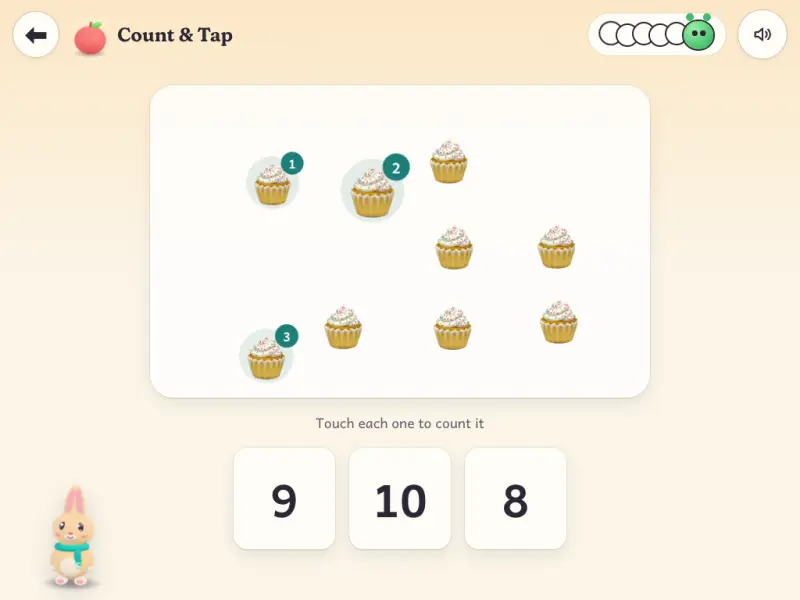
- Count & Tap Free: Count up to 10 objects; the last number says how many (cardinality).
- Quick Look Free: Subitise up to 5 and recognise dice and ten-frame patterns.
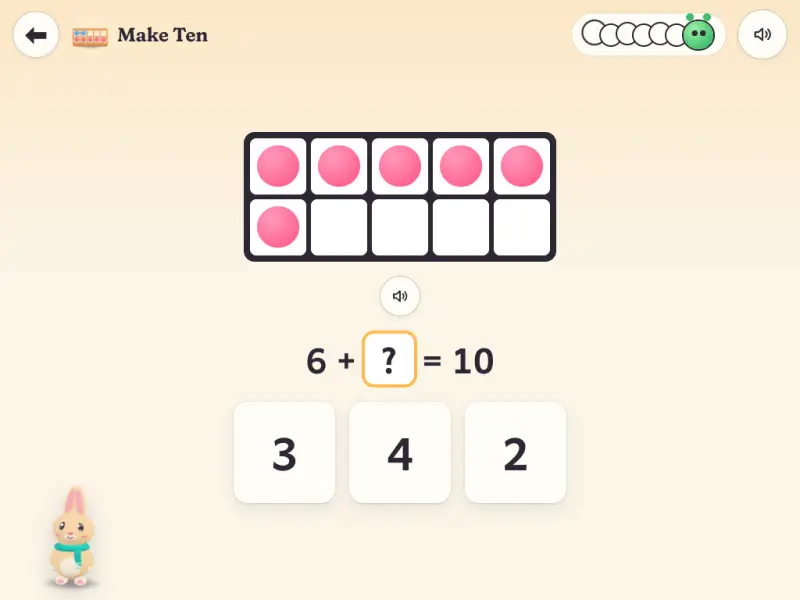
- Make Ten: Know number bonds to 5 and some to 10 (ELG: Number).
- Hop the Line Free: Count along a 0–10 number line to find where a number is (ELG: Number, counting and number sense).
- Hungry Croc Free: Compare two groups up to 10 (more, fewer or the same) and find one more or one less than a number (ELG: Number).
- Shape Hunt Free: Name circles, triangles, squares and rectangles of any size, even when they are turned (ELG: Number and shape).
- Pattern Train: Continue, copy and correct ABB, AAB and ABC repeating patterns, spotting the mistake (ELG: Numerical Patterns).
- Piggy Shop Free: Recognise 1p, 2p, 5p and 10p coins, whatever their size or way up.
- Treasure Map: Understand position through words: on, under, in, next to, behind and in front of (EYFS: spatial reasoning).
See every maths game and the full Reception curriculum.
Questions parents ask
What maths should my child know by the end of Reception?
They should understand numbers to 10 deeply (including how each is made up), recognise up to 5 without counting, know number bonds to 5 and some to 10 by heart, count beyond 20, compare amounts up to 10, and spot patterns such as odd and even numbers and doubles.
Do Reception children learn to add and subtract?
Yes, but through number bonds and real objects rather than written sums. Knowing that 5 is 3 and 2 is the foundation of addition and subtraction in Year 1.
Is my child behind if they cannot count to 100?
No. Reception expects counting beyond 20 with an understanding of the pattern; counting to 100 is a Year 1 objective. Depth with numbers to 10 matters more than counting high.